
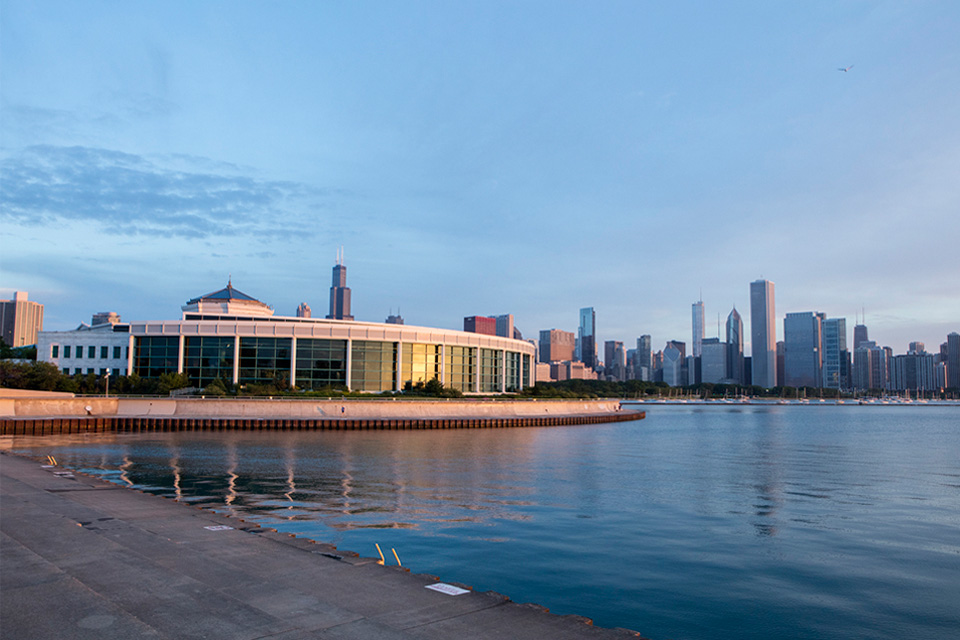
Shedd Aquarium along Chicago’s lakefront, with the city skyline in the background.
Photo courtesy of Shedd Aquarium.
By Martin Hawrysko
Metropolitan Industries
A renowned destination and architectural marvel along the shores of Chicago’s Lake Michigan, Shedd Aquarium is recognized as a National Historic Landmark, welcoming two million guests annually to explore vibrant, immersive exhibits that showcase thousands of aquatic animals and environments.
Beneath each freshwater and saltwater habitat lies a complex, carefully managed operations system that sustains aquatic life and maintains the infrastructure supporting the daily needs of staff and visitors alike. As the historic aquarium approaches its centennial anniversary in 2030, the organization is currently undertaking a substantial, multi-phase physical transformation that will bring new animal exhibits, an expansion of programs, and infrastructure upgrades upon completion in 2027. This experience evolution is part of a larger strategic plan—Shedd’s Centennial Commitment—that is preparing the aquarium for the next 100 years of service.
A pivotal benchmark in the transformation timeline is the anticipated change in the building’s water usage profile with the coming additions of the ‘River Wonders’ and the ‘Living Lakes’ aquatic galleries. The additional demand to maintain the upkeep and periodic maintenance of these new habitats—without affecting the pressure balance that transports domestic water to the rest of the building—brought into question the realistic longevity of the existing pressure booster pump system, which had been in service since 1988.
“We definitely got our investment’s worth, probably about five-times over,” said Bob Wengel, Sr. vice president of facilities and security at Shedd Aquarium. “After nearly 40 years, the booster system was nearing its maximum capacity at its current usage. Given its age and the extra capacity we need as new habitats come on got us thinking about a replacement.”
Preparation got underway in 2023, when Shedd tasked their mechanical-plumbing-engineering team to consider possible designs for a new system. The forward-leaning vision is a testament to how the iconic institution has continued to uphold its standard of operational excellence throughout its first century.
Metropolitan Industries was brought on board as the preferred supplier to design and assemble a custom-engineered booster pump package. According to Wengel, Shedd’s relationship with Metropolitan is a continued collaboration stemming from the success of previous projects—such as the dual pump system that powers the ‘Man with Fish’ fountain statue outside the building’s main entrance.
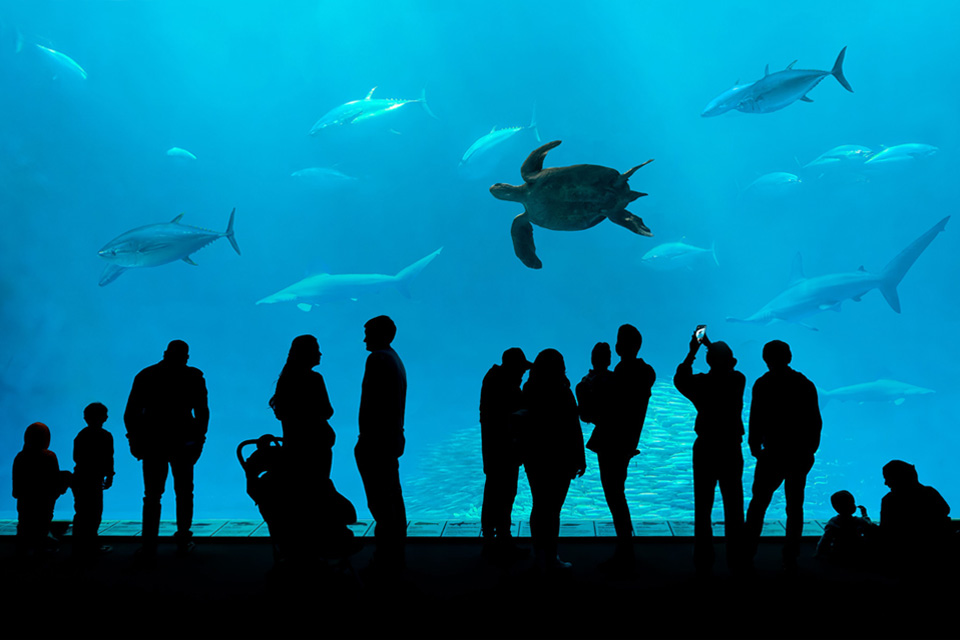
Immersive saltwater habitat viewing panel captivating guests at Shedd Aquarium.
Photo courtesy of Shedd Aquarium.
Advancing Water Conservation Success
A crowning achievement Shedd Aquarium proudly celebrates is the success of their ongoing water conservation efforts. “Between 2012 and 2018, we reduced our water consumption by 50 percent,” Wengel said.
The conservation effort began with multiple water audits, and a thorough examination of the building’s mechanical and raw plumbing uses. Wengel attributed the significant water savings to behavior changes on top of many simple and advanced efforts – from switching fixtures to lower-flow faucets and removing automatic flush valves from toilets to designing a new cooling tower that streamlines heat rejection and energy usage by centralizing refrigeration loops into a single condenser.
“We use a considerable amount of water to support our aquatic animals,” Wengel said. “Over that six year period, we got to a 50 percent reduction in use. The takeaway is, if we can achieve that, so can others.”
In the years since the previous booster was put into service, advancements in energy-efficient pumping and control technologies paved the way for a state-of-the-art solution capable of meeting future water demands and further supporting their conservation efforts.
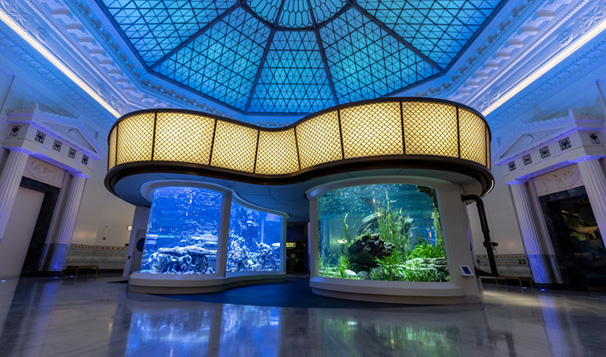
Wonder of Water exhibit showcases aquatic life across expansive freshwater and saltwater habitats.
Photo courtesy of Shedd Aquarium.
A Data-Driven Approach to Equipment Selection
Among Shedd Aquarium’s priorities was implementing real-time monitoring of water flow throughout the building. “Seeing our usage in real time gives us a way to question irregularities and identify sudden increases in gallons per minute or energy usage,” Wengel said. “The monitoring data will help us pinpoint any leaks or energy losses which may compromise the efficiency of our conservation plan.”
“Shedd gave us an overview of the different processes that go on in their building,” said Matt Brickey, commercial sales representative at Metropolitan Industries. “We conducted a detailed flow-study to collect the building’s trending data over a two-week period. We used that information and took into account additional process information to make an informed, data-driven equipment selection.”
The outgoing triplex booster system gave way to a variable-speed, multi-stage quadruplex system. The Metropolitan-engineered package features a downstream flow meter for precise water usage measurement, the MetroTech III Pro controller for seamless monitoring and integration into the building automation platform, and variable frequency drives that automatically adjust pump speeds to maintain setpoint pressures—improving energy efficiency and reducing mechanical wear.
To ensure balanced pressure throughout the building, the booster system incorporates multiple hydropneumatic tanks that manage varying flows and pressures, minimizing large demand fluctuations. This design enables rapid flow adjustments instead of the typical rise-and-fall cycles from conventional systems. The increased efficiency also allows the booster to shut down automatically when no flow is required, improving system efficiency.
A central theme in Shedd’s enterprise risk management strategy is redundancy. The upgrade from a three-pump to a four-pump system enhances backup capacity in case one of the other pumps becomes inoperable, significantly reducing the risk of system downtime. The four pumps are connected to two separate electrical feeds, allowing the building to continue providing water even if one power source fails.
“Shedd is very unique from the standpoint of their water usage,” Brickey said. “Not only do they have regular day-to-day sink and toilet uses, but they also have high-volume processes and fillings necessary to maintaining vital habitats.”
“This is why what we do is so fulfilling,” Brickey added. “Metropolitan understands not every application is the same. Anyone can easily replace an outgoing system with a cookie-cutter system with similar capabilities. We gain a true understanding of how each building operates. And we also gain a true understanding of stakeholder objectives and what they want in a new system, then we put it all together and build it.”
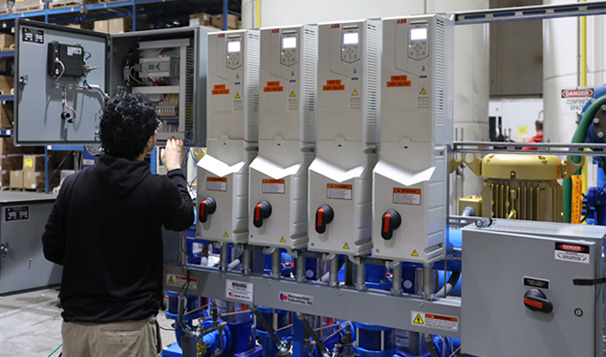
The new pump system for Shedd Aquarium undergoes factory acceptance testing at Metropolitan Industries.
Seamless Transition in Action
The new booster pump system was engineered and assembled by Metropolitan in a factory-controlled environment at our Romeoville, Illinois facility, and the packaged, skid-mounted unit was delivered to Shedd Aquarium ahead of its scheduled July 2025 installation.
A critical priority in the replacement plan was to avoid a prolonged interruption of the building’s domestic water service. The transition required careful planning and additional temporary measures to ensure that the water supply remained available throughout the process. Although the aquarium’s animal life is supported by specialized, independent life support systems designed for continuous, redundant operation, an extended water outage would have disrupted many essential daily operations—like cleaning habitats, sanitizing equipment, and maintaining visitor services—highlighting why minimizing disruption was mission-critical.
“A temporary booster pump and controller provided by Metropolitan allowed Shedd to maintain normal operations during the week-long transition phase,” Brickey said. “The temporary booster went in and kept the building’s water going once the old system went offline. Shedd operated on the temporary booster while the old system was decoupled and removed to make way for the new system.”
A planned shutdown of the building’s water accompanied the temporary booster’s installation—scheduled and executed in the overnight hours to minimize disruption. Brickey was on site during the installation along with a personnel member from Metropolitan’s service department to provide immediate support to the installing contractor if needed. “The temporary booster went in exactly as planned, and the shutdown was limited to only a few hours.”
The supplied pump and motor drive that made up the temporary system were strategically configured to match that of the incoming system. “With only minimal modifications, we were able to do everything we needed from an operational standpoint until the replacement system was brought on,” Wengel said. “No one else in the building would have noticed anything unusual as the old system was being decoupled.”
The new system was commissioned and brought into service one week after the initial shutdown of the old system. Wengel and Brickey credit Ewing Doherty Mechanical, the contracting firm based in Bensenville, Illinois, for completing the one-week transition. “The switchover was seamless,” Wengel said. “After the Ewing Doherty team took out the old system and got the new system and piping in place, they completed the cutover in one night.”
To ensure smooth onboarding for the building’s operational staff, Brickey held on-site training sessions, including comprehensive walkthroughs of the new controls, programming setup, and each setpoint. Wengel added that “Matt was very thorough during the startup and training sessions, making sure everything went along smoothly.”
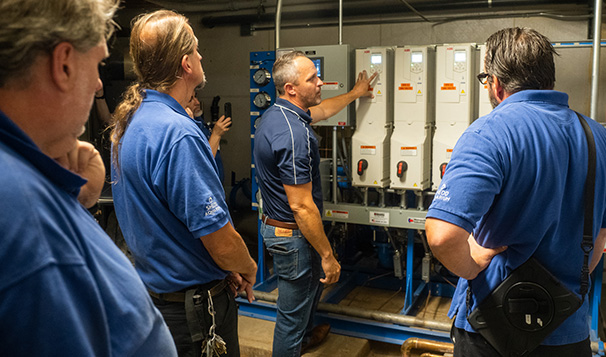
Matt Brickey leads on-site training for Shedd Aquarium staff following installation of the new pump system.
Preserving While Expanding
Wengel looks forward to analyzing the long-term totalized values as the new booster pump system continues to provide real-time trending data over the coming months and years.
The successful upgrade is one of several recent examples of how operational integrity and conservation move in tandem at Shedd Aquarium—what Wengel calls “preserving as we’re expanding.” Wengel hopes these efforts may be judged favorably by whoever is occupying his chair 30 years from now—just as he remains in constant awe of those who came before him.
As the building transformation nears completion and the centennial celebration approaches, Shedd Aquarium stands poised to continue its stewardship of aquatic animal life, champion environmental responsibility, and inspire new generations—well into the next hundred years.
For additional information about Shedd Aquarium’s Centennial Commitment, visit https://www.sheddaquarium.org/about-shedd/centennial-commitment.
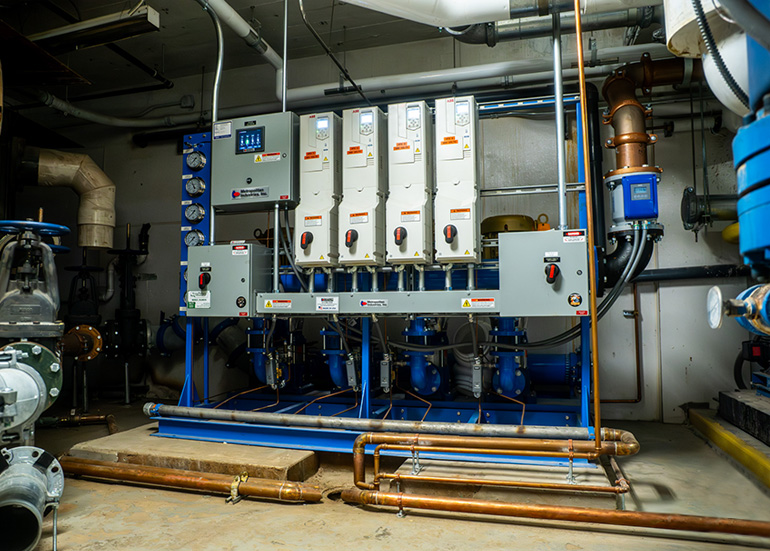
Completed booster pump system actively supporting operations at Shedd Aquarium.
