

Delivery of our large-scale prefabricated booster station to Tinley Park, Illinois job site.
By Shannon Gallagher & Alfredo Melendez
The path water takes from its origin to our taps is a testament to human ingenuity and urban planning. At the heart of this lies a central source—be it a river, a lake, a reservoir, or a well—where water embarks on its transformative journey. Treated to meet the highest standards of safety and quality, this resource travels through an underground network of water mains, the vital arteries of our cities, reaching out to homes, businesses, and public spaces. Water towers and reservoirs stand as guardians of our water supply. Yet, beneath this flow lies a calculated science: the art of maintaining water pressure. These pressure zones, defined by the steady line of hydraulic grade, ensure that water pressure is diligently calibrated to suit the topographical tapestry of our communities, making pressure-boosting systems not just an innovation, but a necessity for the harmonious distribution of water to all.
Nestled in the heartland of America, Tinley Park is a vibrant suburb in Illinois, known for its community spirit and a rich history that has paved the way for its growth from the east side to the west. This westward expansion brought not only prosperity but also the challenge of maintaining adequate water pressure, especially as elevation rose by thirty-five feet from 88th Avenue to LaGrange Road. When Tinley Park was first established, a water tower sufficed for the east side, providing 40-60 psi, but as the town expanded, water pressure inconsistencies began to affect some multi-story buildings, with the potential to impair critical utilities and fire-fighting capabilities. The town’s vigilant officials, closely monitoring the water system and heeding community feedback, were quick to acknowledge the issue and prepared to address the vital need for reliable water pressure.
From Problem to Solutions: A Multi-Party Approach
Collecting essential information serves as the initial step in crafting the right solution. Taking a proactive approach, Tinley Park began to build a water model over the course of a five-year journey, collaborating with Christopher B. Burke Engineering Ltd. (CBBEL). This water flow model illustrates how water circulates within a town and offers insights into drainage patterns, flood risk, and water management. Municipalities rely on these models to assess stormwater control measures, fire flow, and other factors, ensuring safe, efficient, and sustainable water services. “The water model really put it into perspective how bad the west end of town water supply was, it was made obvious that this was a priority.” said John Urbanski, Public Works Director. Together with CBBEL, the village decided to move forward with implementing a solution that created a brand-new pressure zone to serve the west side of town.
The Public Works Department knew they would need funding to make their solution a reality. They worked with Pat Carr, the Village Manager, and the Board of Trustees to explain the benefits of using available funding sources to make necessary upgrades to the west end of Tinley Park. The project was approved and financed by a two-year bond, setting the deadline for its completion. The project, post-approval, was split into two bids: the first for developing LaGrange Road’s water system as the main framework, and the second for the booster station and equipment setup, with Airy’s Inc. securing both contracts. As a result, a dream team was assembled. With the Village of Tinley Park, CBBEL, and Airy’s now on board, the missing piece was Metropolitan Industries. Metropolitan Industries was assigned to design and construct a prefabricated booster station, supply valve components, and collaborate on the optimal building size and pump features, culminating in the creation of the booster and controls system.
The project still had plenty of work to get done. Aside from the prefabricated booster system being added to the West, both the East and West side water systems still needed to be isolated, separating one pressure zone to two. “Right now, the pump station pulls from the biggest of our four main sources, which is what you want for a smooth flow to the west. When we had to separate the west side, there was a lot to think about. We had to figure out the best spot for the station and how to split the system into two pressures up on the hill. It was a bit of a juggling act with everything happening at once” said Kevin Baldwin, CBBEL Mechanical Engineer. CBBEL determined that three pressure sustaining valves needed to be implemented along a predetermined geographical main line. These valves would work in conjunction with the booster house to establish the Western Pressure Zone. Airy’s Inc. swiftly began the construction of pressure sustaining valves, creating a concrete base to house the valve assembly, which was to be constructed offsite due to flood risks at the original location. Meanwhile, Metropolitan Industries crafted SCADA controllers to measure pressure on both sides of the system, along with other vital components such as sump pumps, flood switches, and access hatches. These valves serve as an emergency backup, maintaining proper pressure distribution and allowing for water flow adjustments as necessary. “In an emergency situation the valves are able to revert back to the existing conditions we are seeing today” said Baldwin. With the valves prepared for installation, the focus shifted to finalizing the prefabricated building.
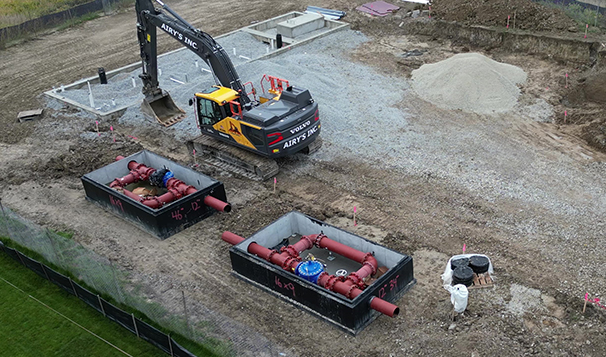
Pressure Reducing Valves at an offsite location.
From Blueprint to Reality: Constructing Tinley Park’s Prefab Water System
Crafting the Post 21 Booster Station was a testament to Metropolitan Industries’ prowess in overcoming the complexities of large-scale prefabrication. Spanning a grand 60 feet by 16 feet, with a towering interior height of 10 feet, the project was a bold stride in infrastructure innovation. “With decades of combined experience and thoroughly reviewed plans,” began Mark Homerding, the Fabrication Manager, “we launched into a whirlwind of activity as materials were ordered and construction began.” The team’s expertise shone as they laid out structural beams, welded, painted, and insulated, breathing life into the booster station.
As the structure took shape, the manufacturing department meticulously installed distribution panels, lighting, and VFDs, while the fabrication team welded and coated pipes, positioning them alongside the pumps. They navigated the challenge of the large pump layout with strategic pre-staging, safeguarded under protective tarps. An overhead crane, built into the station’s very skeleton, ensured efficient assembly and future maintenance. “After six months of dedicated work, involving approximately 3500 hours of welding, wiring, and testing,” Homerding declared, “the project was completed without a hitch.” The result was a marvel of engineering—a weatherproof brick facade crowned with a metal roof, while the interior housed the operational magic: four vertical split case pumps, an automatic transfer switch, electrical controls with SCADA integration, a flow meter, a generator, and all necessary fittings and piping for a direct connection to the job site.

Interior of the booster station with four vertical split case pumps.
To future-proof the Tinley Park project, Metropolitan Industries and CBBEL equipped the system with two sets of vertical split case pumps—one for low and one for high service. Keith Girup, a Metropolitan Municipal Salesman, explained, “We’ve ensured redundancy with two pumps for each service; one operates under normal conditions, while the other stands by as a fail-safe.” The low service pumps cater to everyday water needs, and the high service pumps are reserved for peak demands and emergencies, such as firefighting.
Girup further highlighted the role of the Variable Frequency Drives, which dynamically adjust water pressure by speeding up and slowing down the pumps. This technology provides Tinley’s operators with comprehensive control over the pumps. Additionally, a diesel generator was installed for power outage contingencies, and an integral crane was incorporated to facilitate maintenance and repairs, ensuring the system’s resilience and reliability.
Navigating System Implementation: A Roadmap for Community-Inclusive Installation

Preassembled housed booster station departing manufacturing facility, Metropolitan Industries.
Tinley Park’s commitment to community engagement was pivotal in keeping residents informed about the local booster system project. Through mailers, social media posts, and direct communication, the community was updated on the installation process and services. Airy’s Inc. diligently prepared the installation sites, starting with the excavation for the pressure sustaining valve enclosures and managing water main shutdowns for valve integration. The Village of Tinley Park meticulously checked every valve in anticipation of the increased pressure from the new system.
The delivery of the Post 21 Booster Station was a critical and carefully planned component of the project, marked by a series of carefully orchestrated steps to ensure its success. The logistics teams played a pivotal role, securing the necessary permits and support from local authorities well in advance. They also organized a dedicated crew responsible for loading the structure, which weighed a substantial 90,000 lbs.
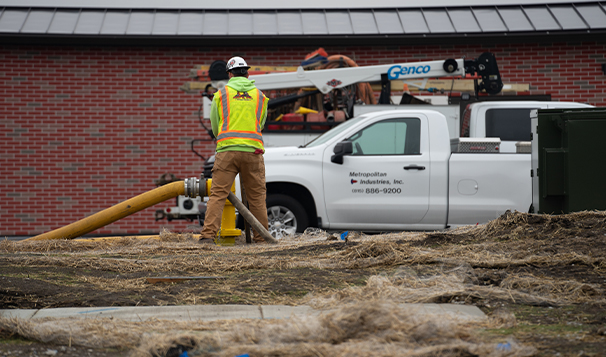
Airy’s preparing Post 21 for housed booster building delivery and startup.
On the day of the delivery, the team from Airy’s Inc. was prepared at the Tinley Park site, coordinating with crane operators for the precise placement of the booster station. The journey from Romeoville, IL to Tinley Park, IL was a significant undertaking, involving a special flatbed trailer designed to handle the oversized load. The route was planned to minimize disruptions and ensure a smooth transit.
As the building arrived, it was a moment of high anticipation. The crane was already in position, ready to offload the massive structure onto its new foundation. This step was crucial as the building needed to align perfectly with the pre-established connections and piping laid out in the foundation. The crane’s rigging were carefully removed once the building was securely in place, signaling a successful delivery. Ken Howard, the Water Foreman of Tinley Park, highlighted the importance of this phase, saying, “The delivery was executed with precision, ensuring that each component was perfectly aligned with the pre-established connections in the foundation as the house was gently settled into place.” The meticulous planning and execution of the delivery were emblematic of the project’s overall attention to detail and commitment to quality. Howard also emphasized the thorough preparation, stating, “Knowing that the installation was going to take place, we [The Village of Tinley] went through every valve in the Western Pressure Zone, checking that bolts were tight and that each valve was touched.” This proactive approach was crucial in managing potential leaks and transitioning the water zones effectively.
Following the installation, a rigorous pre-startup testing phase was initiated, where each pump underwent a series of comprehensive evaluations. “We conducted a variety of tests, discharging water to confirm the pumps operated within the required parameters for different scenarios. This 2-to-3-day testing period proved invaluable, ensuring the system’s excellence upon activation,” explained Tom Land, Airy’s Vice President. With the initial tests concluded, the Post 21 station was ready to go live and create the new Western Pressure Zone. Howard emphasized the cautious approach: “We understood the necessity of gradually enhancing pressure. Our strategy has been, and continues to be, a deliberate slow increase in water pressure to the West end, mitigating the risk of main breaks.”
Empowering Our Community: A New Pressure Zone is Born
As Tinley Park embarks on the final stages of integrating the new Western Pressure Zone, residents are beginning to experience the tangible benefits of increased water pressure. “Public health and safety are paramount when it comes to water systems,” Urbanski remarked. “The enhanced pressure not only improves daily water use but also ensures significant long-term cost savings.” The completion of the Post 21 Booster Station, a landmark in Metropolitan Industries’ history of prefabricated structures, alongside the timely finish of the pressure sustaining valves, marks a collective triumph. Urbanski expressed his satisfaction, “Seeing the collaboration and dedication from everyone involved has been remarkable.” Echoing this sentiment, Girup added, “Being part of this pivotal project has been a privilege, and I look forward to the positive impact it will have on Tinley Park.” With vigilant operation, monitoring, and maintenance, the Western Pressure Zone stands as a beacon of community well-being and a foundation for future growth.
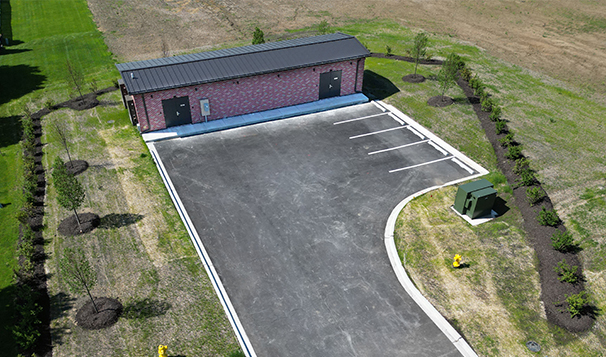
Landscaping surrounding Post 21 housed booster station.
