
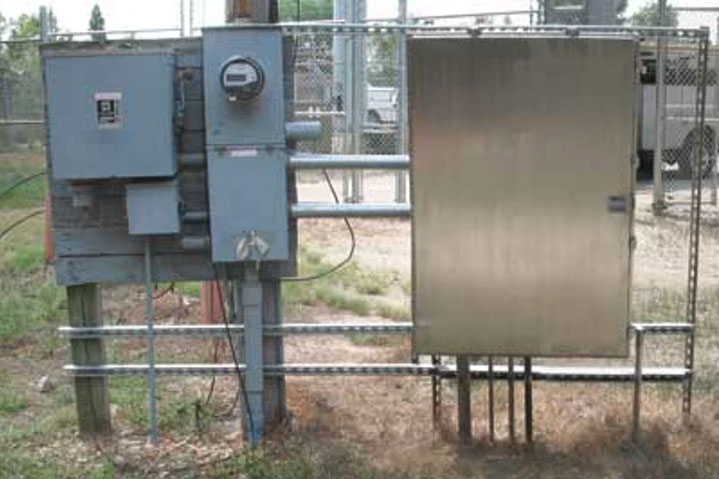
Lift station controls before the upgrade took place.
Published in January 2014 Issue of WaterWorld Magazine
Expectation of future residential and industrial expansion to the City of Rock Falls, Ill. has contributed to the need for a recent upgrade to a 50 year old lift station. The station, built in the 1960s, was antiquated and the decision to install a more reliable lift station could not have come at a better time.
A renovation to the Rock Falls Water Reclamation Facility, completed in July 2011, brought an opportunity to upgrade the City’s lift stations as well. Metropolitan supplied new Control Panels to all ten of Rock Falls lift stations. The city chose Metropolitan Industries to provide an efficient and more versatile controller, the LMS II, an intuitive, pre-programmed wet well level controller that gives users access to basic SCADA features.
The LMS II was installed to provide the city with a more reliable way to remotely access data, which Superintendent of the City of Rock Falls Water Reclamation Facility, Ed Cox, describes as the best decision the City ever made.
“The WWTP and collection system was far behind in software innovations,” Cox said, “the LMS II helps save us time and gives us the ability to view trends.”
Working with engineering firm, Willett Hofmann & Associates of Dixon, Ill. and Metropolitan Industries Municipal Salesperson, Dan Howorth, Cox knew the LMS II was something that was going to positively change the City’s system.
“The LMS II has given our personnel the opportunity to respond better to alarms,” said Cox, “We can see exactly what the problem is before driving out to any of the stations, which in return has allowed us to save time throughout our day.”
The LMS II product was installed in the city’s largest lift station, which services 1/3 of the people of Rock Falls. The upgrade has provided many benefits, including saving monthly water costs.
As an upgraded version of the control panels that were previously installed in the Rock Falls Lift Stations, the LMS II has many cost saving benefits; assists with the day-to-day operations; and provides a better data collection system.
“All ten of our stations are supplied with Metropolitan panels,” Cox said, “The goal now is to slowly integrate the LMS II into the rest of the Rock Falls stations.”
The upgrade to the lift station is complete with two running pumps with the capability to run a third pump for the City’s future expansion.
The original station was an underground dry-pit station that could not be entered into without confined space measures. The station was at full capacity and could not handle any additional flow with the industrial park expanding. The controls were underground and were under constant flooding danger.
The new station was built next to the original station, which allowed for a seamless transfer. There wasn’t any concern with the stopped process of water because the original station was running until the switch to the new station was made.
“That’s the goal, we wanted to flip a switch and have no one in the world know what was done, or changed,” Cox said “And that happened with this project. We had tremendous customer service with Metropolitan, they were there every step of the way. Informing us of delays and immediately handling any concerns,” he added, “this was a job I didn’t have to worry about because I could trust in Metropolitan to get it done, and that made me really happy.”
The project adheres to Metropolitan’s mission to provide the customer with the utmost attention and satisfaction, while also providing a smooth transition to an upgraded system.
